Does Color Temperature Actually Affect Brightness?
The one spec that really controls how bright your LED strips are — and it’s not Kelvin.
By Inspired LED | inspiredled.com | 480-941-4286
The Most Common LED Misconception
If you’ve ever shopped for LED strip lights, you’ve probably asked yourself some version of this question: “Does a higher Kelvin number mean the light is brighter?”
It’s a completely logical assumption. Higher numbers usually mean more of something. And when you hold a warm white strip next to a cool white strip, the cool one does look brighter (or at least more intense). So, it’s easy to connect the dots and assume that Kelvin and brightness are related.
Here’s the truth: Kelvin and brightness are two completely different things. One describes what color the light is. The other describes how much light there is. They’re about as related as the color of a paint can and the size of the can, where the appearance doesn’t tell you anything about the quantity.
And while cooler (higher Kelvin) LED strips do sometimes produce a few more lumens than their warmer counterparts at the same density, the real driver of brightness in LED strip lights is something else entirely: the number of LED chips packed into each foot of strip.

What Kelvin Actually Measures: The Color of Light
Kelvin (K) is the unit of measurement for color temperature in lighting. It describes how warm or cool the light appears, which is the color cast it gives to the objects and spaces it illuminates.
Think of it like a spectrum from firelight to daylight. At the warm end, 2700K gives you that golden, amber glow you associate with candles or old-style incandescent bulbs. At the cool end, 6500K gives you the bright, blue-white light of an overcast sky or a photographer’s daylight bulb. Everything in between is a different shade of white.
Kelvin has nothing to do with how much light is being produced. It only describes what color that light is. A 2700K strip and a 6500K strip of the same density will look and feel very different but their brightness difference will be minimal.
The Kelvin Color Temperature Spectrum
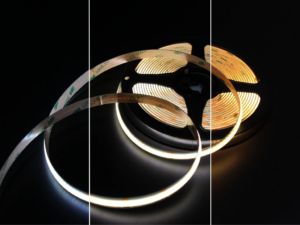
 Kelvin describes color appearance, not brightness. Moving from 2700K to 6500K changes the feel of a space dramatically and adds only a small amount of additional lumen output.
Think of It This Way
Two 100-watt bulbs — one warm amber, one cool blue-white — produce roughly the same amount of light. The cool one may look more intense because our eyes associate blue-white light with daytime alertness. But point a light meter at both and the numbers are almost identical. The same principle applies to LED strip lights.
What Lumens Actually Measures: The Quantity of Light
Lumens (lm) measure the total amount of visible light produced by a light source. Where Kelvin asks “what color is this light?”, lumens ask “how much light is there?”
For LED strip lights, brightness is expressed in lumens per foot (lm/ft) or lumens per meter (lm/m). This number tells you directly how much light output you can expect from each foot of installed strip.
When you’re deciding how bright your lighting will be, whether it will function as subtle accent lighting or as primary task illumination, lumens per foot is the number to look at. Not Kelvin.
Quick Definitions
Kelvin (K) = Color temperature. Measures the warmth or coolness of the light’s appearance. Does NOT measure brightness.
Lumens (lm) = Light output. Measures the actual quantity of visible light produced. This IS brightness.
Lumens per foot (lm/ft) = Brightness per unit length of LED strip. The number to compare when choosing how bright your install will be.
The Real Story: Does Kelvin Affect Brightness at All?
Here’s where it gets interesting and where we can settle this with real numbers from our product line.
Yes, within a given LED strip density, a cooler color temperature does sometimes produce slightly more lumens than a warmer one. The human eye is more sensitive to the green and blue wavelengths of light that cooler LEDs emit more of, so a cool white strip can appear brighter even when the lumen numbers are close. And the lumen numbers do sometimes show a small gap.
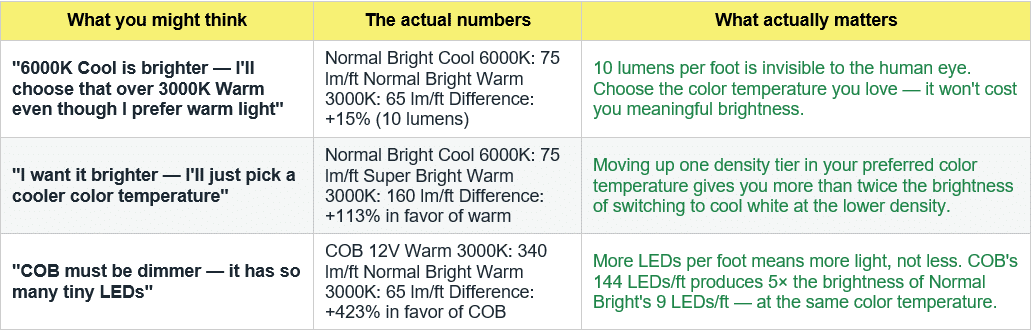
But here’s the thing: the difference is small. Across our product line, the gap between the warmest and coolest version of the same strip is typically between 3% and 15%. In real-world lighting, a 10% lumen difference is effectively invisible unless you’re holding a measuring instrument.
Compare that to the impact of choosing a denser strip — and the Kelvin effect becomes completely irrelevant.
Proof from our product line: Kelvin difference within the same density
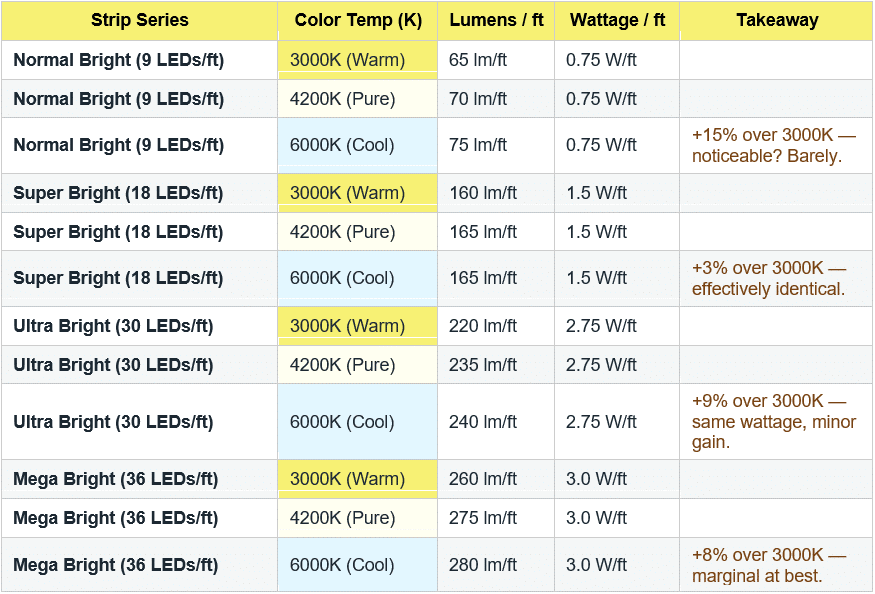
The pattern is clear. At Normal Bright density, the warmest-to-coolest difference is 10 lumens per foot (about the brightness of a birthday candle per foot of strip). At Super Bright density, the difference is zero. At Mega Bright, it’s 20 lumens — across three wattages that are all identical.
In short: within any given strip series, choosing warm vs cool changes your mood, not your brightness in any meaningful way.
The Bottom Line on Kelvin and Brightness
The lumen difference between the warmest and coolest version of any Inspired LED strip is between 0% and 15% depending on the series. At the lower end, this is invisible to the human eye. At the upper end, it’s a difference you’d need a light meter to confirm. It is never large enough to be the reason you choose a color temperature you don’t prefer.
What Actually Makes LED Strips Brighter: LED Density
If Kelvin isn’t the answer, what is? The answer is sitting right there in the product name: the number of LEDs packed into every foot of strip.
LED density, measured in LEDs per foot or LEDs per meter, is the primary driver of lumen output. More chips per foot means more light per foot. It’s that direct. And unlike the modest Kelvin effect, the density effect is enormous.
Look at what happens when you move through our 12V single-color lineup — all at the same warm 3000K color temperature, nothing else changing:
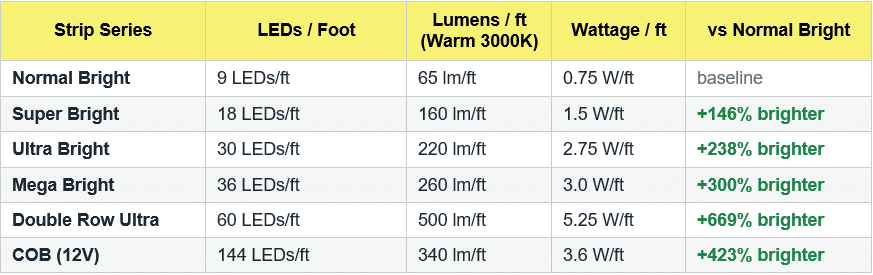
Read that again: going from Normal Bright (9 LEDs/ft) to Double Row Ultra (60 LEDs/ft) at the exact same 3000K warm color temperature gives you nearly 8 times the brightness. Meanwhile, going from 3000K Warm to 6000K Cool at Normal Bright density gives you 10 extra lumens per foot.
Density is the lever. Kelvin is the knob.

The 24V lineup tells the same story
The same principle holds across our 24V professional strips. Here’s a snapshot of 24V options at warm color temperatures — showing how density and wattage drive brightness far more than Kelvin ever could:
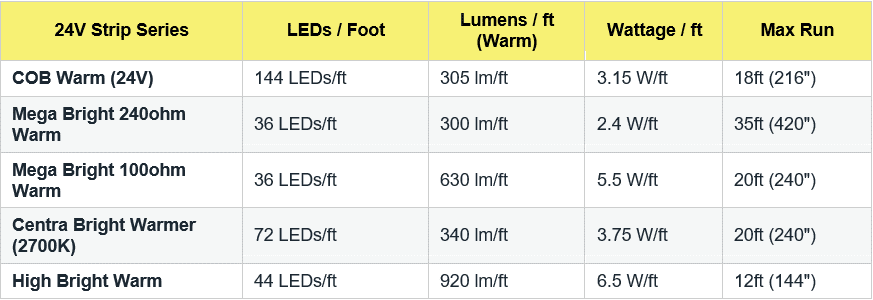
The 24V High Bright Warm at 44 LEDs/ft produces 920 lumens per foot at warm 3000K. That is more than twice the output of the 24V COB Warm at 144 LEDs/ft, because the COB chips are optimized for smooth diffusion rather than maximum output. Different tools for different jobs! Both are warm, yet both vastly different in brightness.
Three Misconceptions — Busted with Real Numbers
How to Actually Choose: A Two-Step Process
Now that you know Kelvin and lumens are independent, here is the correct sequence for choosing an LED strip:
Step 1: Choose your color temperature based on the mood you want
This is a personal, aesthetic decision and it’s the right first question. Think about how you want the space to feel:
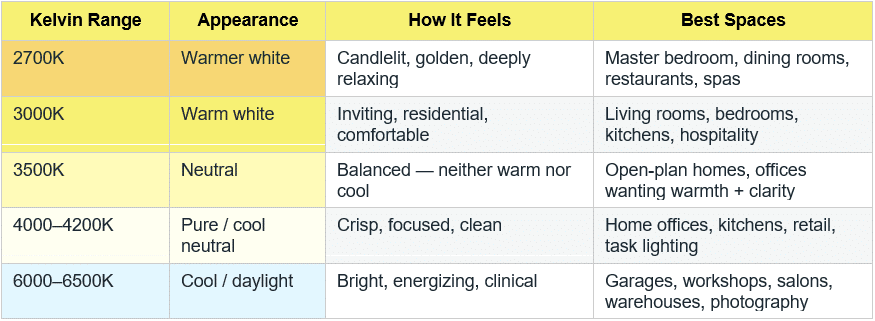
Choose the Kelvin temperature that matches the atmosphere you’re going for. Don’t let brightness concerns push you toward a cooler temperature if you’d prefer warmth. You can always get the brightness you need from the right density at your preferred Kelvin.
Step 2: Choose your density based on how bright you need the space to be
Once you know what color temperature you want, look at lumen output to find the right density for your application:
- Accent and ambient lighting (subtle glow, decorative): 150–250 lm/ft — Normal Bright or Super Bright series
- General living room / bedroom mood lighting: 200–350 lm/ft — Super Bright, Ultra Bright, or COB series
- Kitchen under-cabinet task lighting: 300–500+ lm/ft — COB, Mega Bright, or Ultra Bright series
- Primary room illumination (replacing overhead fixtures): 500–1000+ lm/ft — Double Row Ultra, High Bright, or 24V Mega Bright series
- Commercial or industrial task lighting: 900–1050+ lm/ft — 24V High Bright series
The Simple Rule
Pick the color temperature that makes the space feel right. Then pick the density that makes it bright enough. These are two separate decisions made in that order. Kelvin does not choose your brightness — you do, by choosing the right series!
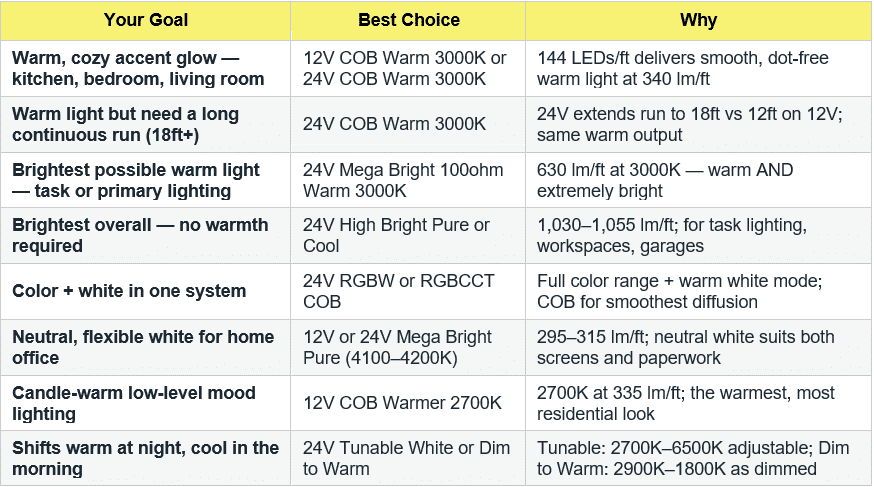
Quick-Pick Guide: What to Choose for Your Project
Use this table to find the right starting point for common installation goals — matched to actual Inspired LED products at the color temperature that suits each application best.
Frequently Asked Questions
Does a higher Kelvin number mean a brighter LED strip?
Not in any meaningful way, no. Within the same LED strip density, a cooler color temperature (higher Kelvin) may produce a few percent more lumens than a warmer version — but the difference is typically 5 to 15 percent at most, and often invisible to the human eye. The far bigger driver of brightness is LED density: the number of LEDs per foot. Choosing a denser strip at your preferred color temperature will always out-brighten switching to a cooler strip at a lower density.
What is the difference between Kelvin and lumens?
Kelvin measures color temperature — how warm or cool the light looks, on a scale from candlelight yellow (2700K) to cool daylight blue-white (6500K). It says nothing about how bright the light is. Lumens measure the actual quantity of visible light produced — how bright the strip actually is. These are two completely independent measurements. A warm 3000K strip can be dim or extremely bright depending on its density. A cool 6500K strip can be equally dim or bright. When you want more light, look at lumens, not Kelvin.
I want warmer light but I’m worried it won’t be bright enough. What should I do?
Choose a higher-density strip in your preferred warm color temperature rather than compromising on color temperature to get brightness. For example, upgrading from a 12V Normal Bright Warm (65 lm/ft) to a 12V Mega Bright Warm (260 lm/ft) gives you four times the brightness, while maintaining the same cozy 3000K color temperature. You never need to sacrifice warmth to get brightness.
What Kelvin temperature is best for a living room?
For most living rooms, 2700K to 3000K (warm white) is the most popular and most flattering choice. This range creates the inviting; relaxed glow associated with residential interiors and incandescent bulbs. If your living room also doubles as a workspace or reading room, 3000K or 3500K gives you a slight bit more clarity without losing warmth. Cool white (5000K+) is generally not recommended for living rooms as it can create a clinical, office-like atmosphere.
What does CRI mean, and should I care about it?
CRI (Color Rendering Index) measures how accurately a light source shows the true colors of objects, on a scale of 0 to 100 where 100 is perfect sunlight. A high CRI means paint colors look true, food looks appetizing, and skin tones appear natural. A low CRI makes everything look slightly washed out or off-color. For most residential and commercial applications, look for CRI 90 or above. Inspired LED’s COB strips and many of the Mega Bright series reach CRI 92–97.
Which Inspired LED strip is best for under-cabinet kitchen lighting?
For under-cabinet kitchen lighting, we recommend a 3000K or 3500K strip at medium to high density. Our Mega Bright or COB series are both excellent choices. Color temperature: 3000K gives you warm, inviting kitchen light; 3500K or 4000K gives you slightly more clarity for food prep. Brightness: aim for at least 200 lm/ft for task lighting. For runs under 12 feet, the 12V COB Warm 3000K (340 lm/ft) is our most popular under-cabinet recommendation.
Why do COB strips have so many LEDs per foot?
COB stands for Chip-on-Board. Instead of individual LED chips spaced at intervals along a strip, COB technology packs a continuous, dense line of micro-chips (144 per foot on our strips) that emit light as a seamless, unbroken line. This eliminates the ‘dotted’ effect you can see with lower-density strips and produces a smooth, premium glow. It also means COB strips can be cut at very short intervals (every 0.98 inches on 12V COB) without wasting a large portion of the strip.
Is 24V brighter than 12V for the same strip?
Not inherently. Voltage affects run length and efficiency, not raw brightness. A 24V COB Warm strip produces about 305 lm/ft; a 12V COB Warm strip produces about 340 lm/ft — slightly different because the 24V version draws slightly less wattage (3.15W/ft vs 3.6W/ft). The real advantage of 24V is that it supports longer runs before voltage drop becomes visible: 18ft vs 12ft for COB. Choose 12V for shorter runs; choose 24V when you need to go longer without a power injection point.
TL;DR (The Short Version)
Kelvin is the color of your light. Lumens is the brightness of your light. They are independent of each other.
Within the same strip series, a cooler color temperature produces a small number of additional lumens — somewhere between barely noticeable and genuinely invisible to the naked eye. It is never a large enough difference to be worth choosing a color temperature you don’t prefer.
If you want more brightness, move up to a higher-density strip in your preferred color temperature. The lumen gains from increasing density are measured in hundreds of percent, not single digits. That is the lever that actually matters.
Choose warm white because you want warmth. Choose cool white because you want crispness. Then choose your density because you want brightness. In that order.
Not sure which series is right for your space? Our team is here to help — whether you need a cozy 2700K bedroom accent or a blazing 1,000+ lm/ft commercial task strip.