Choosing between 12V and 24V LED strip lights is one of the most common questions we hear at Inspired LED (and for good reason!). Pick the wrong voltage for your project and you could end up with uneven brightness, frustrating voltage drop, or a system that simply won’t scale the way you need it to.
The short answer: 12V strips are the go to choice for shorter DIY runs and accent lighting, while 24V strips shine in longer commercial installations, high-output cove lighting, and applications where voltage drop would otherwise be a problem.
But the decision is rarely one-size-fits-all. In this guide, we’ll break down exactly how 12V and 24V LED strip lights differ by covering run length, brightness, voltage drop, cost, and the specific use cases where each voltage wins.
Quick Answer
For most homeowners and DIY projects under 16 feet: choose 12V. For commercial installs, long runs, or high-brightness applications: choose 24V. When in doubt, 24V gives you more flexibility.
What Do 12V and 24V Actually Mean?
The voltage rating on an LED strip light refers to the DC (direct current) input voltage required to power the strip. Both 12V and 24V LED strips run on safe, low-voltage DC power, which is a major advantage over traditional line-voltage (120V AC) lighting systems.
In practice, you’ll use an LED driver (also called a power supply or transformer) to convert standard 120V AC household current down to either 12V DC or 24V DC. The strip, the driver, and any controllers or dimmers must all be matched to the same voltage. Mixing voltages is the single most common mistake.
Low-Voltage LED Safety Advantage
Both 12V and 24V LED strip lights operate well below the 50V threshold considered safe to touch, making them ideal for DIY installation without licensed electrical work in most jurisdictions. Always verify local NEC code requirements before installing.
Voltage Drop: The Most Important Difference
Voltage drop is the #1 technical reason to choose 24V over 12V. It’s the factor most buyers overlook until they’re dealing with dim ens on a long strip run.
As electricity travels through the copper traces in an LED strip, resistance causes the voltage to gradually decrease along the run.
It’s similar to skipping rocks! When you skip a rock, each bounce takes away some of its energy. At first, the skips are far apart because the rock has a lot of energy (like voltage). As it keeps skipping, it loses more and more energy. The skips get closer together, until finally, the rock sinks–out of energy.
 At 12V, this drop becomes noticeable much sooner than at 24V. The result: LEDs at the far end of the strip appear dimmer than those near the power feed, creating an uneven, frustrating look.
The math behind voltage drop
Voltage drop is proportional to current draw (amperage) and wire resistance. Because a 24V system operates at half the current of a 12V system for the same wattage output, resistance-induced losses are dramatically lower.
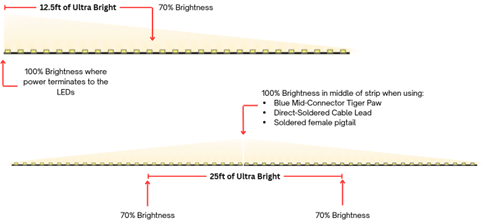
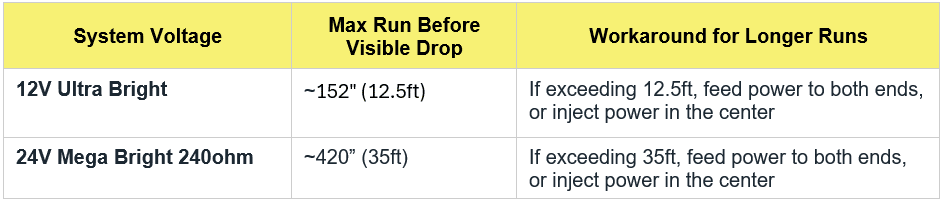 Just know, voltage drop is subjective! Some find it more noticeable than others. You are always welcome to push these max runs as needed. People tend to notice voltage drop once the light output dips under 70%. An example with out Ultra Bright is illustrated below:
Brightness and Light Output
Voltage alone doesn’t determine brightness. The density of LEDs on the strip (measured in LEDs per foot or meter) and the wattage per foot are drivers of lumen output. However, 24V systems do offer a practical brightness advantage in one important way.
Because voltage drop is lower on 24V systems, brightness stays consistent along the entire length of the run. On a 12V strip pushed beyond its recommended run length, you’ll see a noticeable gradient from bright to dim. On a properly deployed 24V strip, brightness is uniform from end to end. which matters enormously in visible installations like cove lighting.
Additionally, high-density and high-output LED strip products — strips with 120, 240 or even 480 LEDs per meter — are more commonly 24V configurations, since higher wattage-per-foot strips benefit more from the lower current draw of 24V.
12V vs 24V LED Strip Lights: Full Comparison

When to Choose 12V LED Strip Lights
12V LED strips are the most widely used configuration for residential and light commercial applications. Here’s when 12V is the right call.
- Under-cabinet kitchen lighting — short runs, close power supply access, no voltage drop concern
- Accent lighting in entertainment centers, shelving, or display cases
- Bedroom and closer lighting where runs are short and the power supply can be centrally located
- Battery-powered or portable lighting applications 12V is compatible with common battery systems and automotive power.
- DIY projects where simplicity matters, 12V system have the largest selection of plug-and-play components.
- Retrofit installations where an existing 12V power supply is already in place.
When to Choose 24V LED Strip Lights
24V LED strips are the professional’s choice for any installation that demands long runs, consistent brightness, or high output. Choose 24V when:
- You’re lighting a cove, tray ceiling, or architectural feature that requires uniform brightness across a long span.
- Commercial installations — retail display lighting, restaurant ambiance, hotel corridors, and office accent lighting all benefit from 24V’s scalability.
- You need high-output strips for task lighting or anywhere the strips will be the primary light source, not just accent.
- Contractor or electrician installs where compliance with NEC low-voltage wiring standards is a priority
Pro Tip: Designing a kitchen? Go 12V
If you’re planning a kitchen installation and aren’t sure which voltage to choose, 12V is a safe decision. This user friendly, cost-effective product is great for residential applications. Inspired LED carries a variety of brightness levels and compatible accessories, perfect for any space. Task like options offer a great range of dimming capabilities and light output variation.
Matching Your Components: Drivers, Controllers, and Dimmers
One of the most important rules in low-voltage LED lighting is that every component in your system must share the same voltage. Your LED strip, power supply (driver), dimmer, and controller must all be rated for either 12V or 24V. They should never be mixed!
LED Drivers (power supplies)
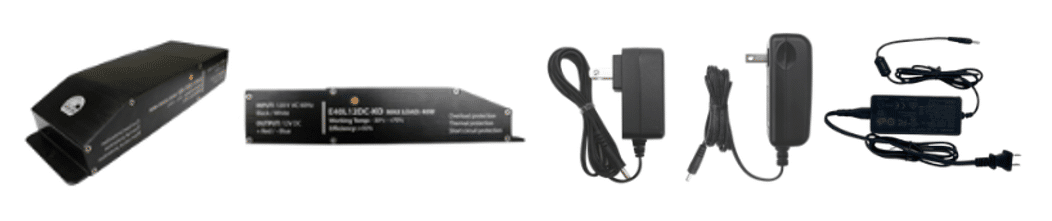
Your LED driver converts 120V AC wall power to DC output. Always match the driver output voltage to your strip voltage. Size your driver by calculating total wattage (watts per foot × total feet) and adding a 20% overhead buffer. For example, a 30-foot 24V strip drawing 2.5W/ft needs a 24V driver rated for at least 90W (30 × 2.5 × 1.20 = 90W).
Dimmers and Controllers
PWM (pulse-width-modulation) dimmers and RGB/RGBW controllers are available for both 12V and 24V systems. Verify the voltage rating before purchasing. At Inspired LED, the majority of our PWM dimmers can be used with either 12V or 24V systems.

Cost Comparison: 12V vs 24V
The price difference between 12V and 24V LED strip systems is smaller than most buyers expect. Here’s a realistic breakdown.
- LED Strip Cost: 12V and 24V strips of equivalent quality and LED density are priced nearly identically at Inspired LED
- Driver cost: 24V drivers are the same price as 12V drivers at the same wattage and from the same manufacturer
- Long-term savings: Both 12V and 24V LED systems are highly energy-efficient. The voltage choice has minimal impact on operating cost.
Frequently Asked Questions
Can I use a 12V power supply with a 24V LED strip?
No. Power a 24V LED strip from a 12V supply will result in very dim output or no output at all. The strip requires the correct input voltage to the drive its LEDs at their rated current. Always match the driver voltage to the strip voltage.
What happens if I use a 24V driver on a 12V strip?
Applying 24V to a 12V LED strip will overdrive the LEDs, causing them to run extremely hot, burn out rapidly, or fail immediately. This will void any warranty and can create a fire risk. never exceed the rated voltage of your LED strip.
Can I connect 12V and 24V strips in the same installation?
Yes, but each zone must have its own correctly rated power supply. You cannot run a 12V strip and a 24V strip from the same driver. Some installers use separate power supplies for each voltage zone in a mixed installation.
Do 12V and 24V LED strips look different?
When properly installed without voltage drop issues, a quality 12V and 24V strip from the same product line will look identical in terms of color and brightness. The visible difference only appears when 12V strips are run beyond their recommended length and voltage drop creates dimming at the far end.
Is 24V safer than 12V?
Both are safe, low-voltage DC systems well below hazardous thresholds. 24V does carry slightly more energy than 12V, but both are used safely in residential and commercial settings. Neither requires a licensed electrician for the low-voltage wiring itself in most U.S. jurisdictions, though the 120V line-side of the driver installation may require one.
What voltage do most LED strip lights use?
12VDC is historically the most common voltage for residential LED strip lights. However, 24V has grown significantly in market share over the past several years as professional installers have recognized its advantages for longer runs and commercial applications. At Inspired LED, we offer both voltage across our full product line.
Can I extend my LED strip run by adding more strips end-to-end?
You can connect LED strips end-to-end using connector or soldering, but the total run from the power supply still cannot exceed the recommended maximum without voltage drop occurring. to extend your effective run length, use a power injection by feeding power at multiple point along the run, rather than simply chaining strips.
The Bottom Line
Choosing between 12V and 24V LED strip lights comes down to your run length, installation complexity, and performance requirements:
- Choose 12V if you’re lighting shorter runs, doing a DIY project, installing a residential project, or need the simplest possible setup.
- Choose 24V if your run exceeds 16 feet, you’re doing a commercial installation, or you want maximum flexibility and brightness consistency.